A Clear Nags Head Investment Property Guide for Investors
May 28, 2026
May 28, 2026
If you are looking at Nags Head as a vacation-rental investment, the big question is simple: can the numbers hold up once you factor in seasonality, insurance, and coastal risk? That is the right question to ask in this market. Nags Head sits in the center of a major visitor economy, but strong gross revenue potential does not automatically mean strong investor performance. In this guide, you will see what drives rental demand, what separates oceanfront from oceanside returns, and how to underwrite a Nags Head property more clearly. Let’s dive in.
Nags Head sits in the core of the Outer Banks tourism economy. The Outer Banks Visitors Bureau describes it as the heart of vacationing on the Outer Banks, and Dare County tourism reports that visitor spending topped $2.1 billion in 2024 while supporting 12,260 jobs.
That tourism base matters because short-term rental performance starts with demand. In Nags Head, that demand is supported by public beach access, Jockey’s Ridge, Jennette’s Pier, the Outer Banks Fishing Pier, restaurants, and a long-established vacation-home market.
AirDNA’s public market overview also points to a large and active rental base. It shows 1,819 active vacation rentals, a 63% occupancy rate, an average daily rate of $534, and RevPAR of $337.40 in Nags Head.
Those are strong headline numbers, but they should be read alongside local trend data. The latest county district report shows Nags Head posted $12.75 million in gross occupancy receipts in January through March 2026, which was down 3.4% from the same period in 2025.
If you picture Nags Head as mostly small beach cottages, the current inventory data tells a different story. AirDNA shows the listing mix leans heavily toward larger homes, with 33% at 5+ bedrooms, 27% at 4 bedrooms, and 24% at 3 bedrooms.
That matters because your competition is often built for group travel. Families and larger vacation groups tend to compare layout, sleeping capacity, amenity package, and beach access very closely.
AirDNA also shows that 59% of listings appear on both Airbnb and Vrbo. That suggests multi-channel distribution and professionalized management are common in this market.
For an absentee owner, that is an important signal. Nags Head is not a market where you should assume light-touch management will keep pace with better-positioned homes.
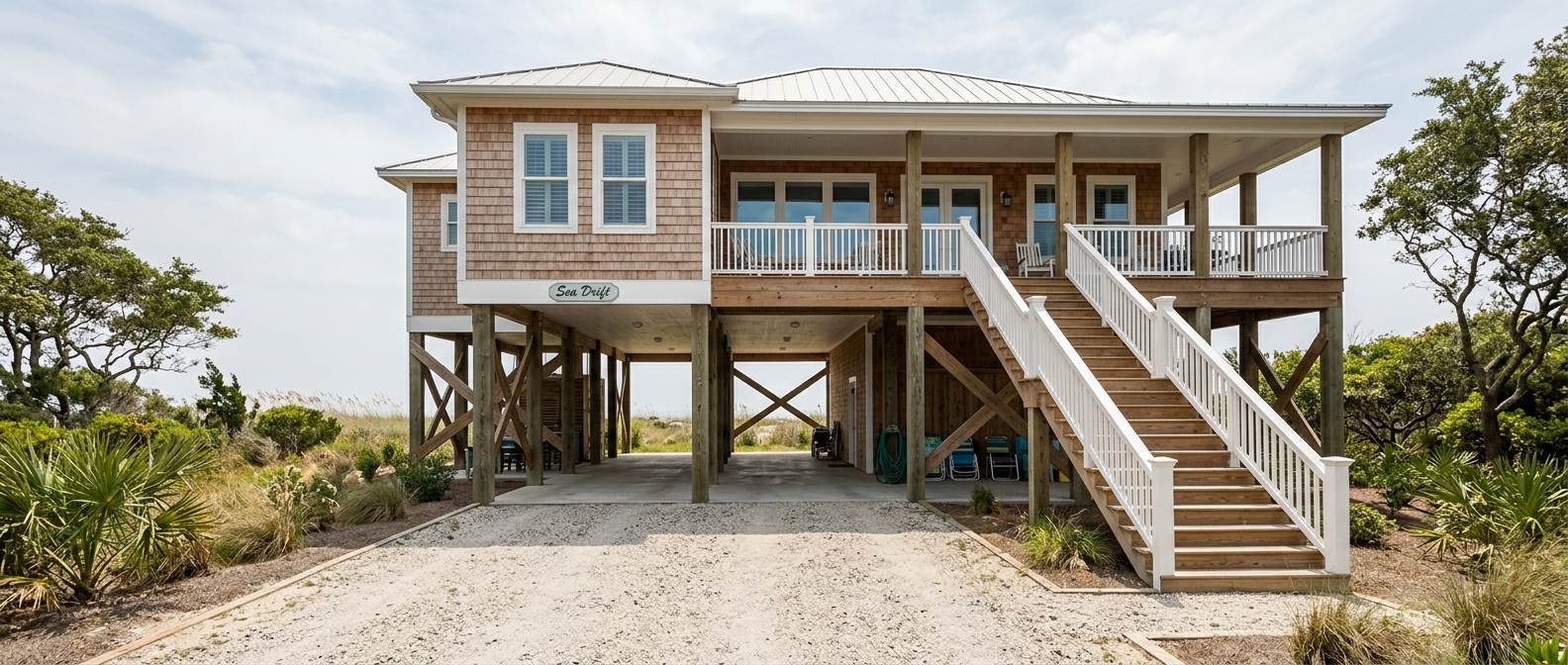
In Nags Head, frontage and beach access have a major effect on pricing power. The Outer Banks Visitors Bureau defines oceanfront as directly on the beach, while oceanside and oceanview homes are typically on the east side of Route 158 and often come in at lower price points while still offering convenient beach access.
For investors, that creates a familiar tradeoff. Oceanfront usually brings a higher revenue ceiling because of views and walkability, while oceanside may offer a lower entry basis and, in some cases, a better risk-adjusted yield.
Current advertised examples in Nags Head show how much frontage and amenities can shift the top line. Oceanfront homes have been marketed from roughly $1,525 to $4,225+ per week in some cases, while amenity-heavy oceanfront properties have been listed from about $3,890 to $25,490+ per week.
By comparison, oceanside examples in the same market have been advertised around $1,325 to $3,225+ per week and $1,525 to $3,125+ per week. These are asking ranges, not realized rents, but they show the pricing gap you need to account for when comparing purchase options.
One of the most important facts for investors is that Nags Head is highly seasonal. Based on the 2025 Outer Banks gross occupancy summary, June, July, and August accounted for about 64% of annual gross occupancy receipts.
The concentration gets even clearer when you zoom out slightly. May through September represented about 80% of annual gross occupancy receipts, which means a large share of annual revenue is compressed into a relatively short booking window.
That seasonality does not mean the rest of the year is irrelevant. It means your underwriting should be realistic about lower off-season demand and should place real value on shoulder-season strategy.
The Outer Banks Visitors Bureau notes that larger oceanfront homes are often booked nine to 12 months in advance for June through September stays. It also notes that April through May and October through December are often booked later and at discounted rates.
For investors, the takeaway is simple: your annual result is not only about peak summer pricing. It is also about how well the home stays competitive before and after the high season.
The Outer Banks Visitors Bureau recommends searching vacation homes by amenities such as pools, hot tubs, linens, and pet-friendly features. In practice, that aligns with how current Nags Head inventory is positioned.
Homes at the top of the advertised rate range often include combinations of private pools, hot tubs, elevators, cabanas, beach walkways, and strong outdoor living areas. Simpler homes without those features tend to sit lower in the market.
Because Nags Head inventory skews toward 3-, 4-, and 5+ bedroom homes, the most valuable improvements are often the ones that make the home work better for groups. That can include:
The available data does not prove that one specific upgrade creates a fixed rate increase. What it does show is that homes with stronger amenity packages tend to occupy the upper end of the advertised market.
If your goal is maximum gross revenue potential, oceanfront usually leads. Direct beach frontage, views, and walkability can support stronger rate positioning, especially in larger homes with premium amenities.
This is why many of the most expensive weekly listings in Nags Head sit in the oceanfront category. The ceiling is higher, and for the right asset, that can be compelling.
Oceanfront is not automatically the better investment. Higher purchase prices, higher storm exposure, and potentially heavier insurance and maintenance costs can narrow the gap between gross income and actual owner returns.
That is where oceanside homes often become attractive. If you can buy at a lower basis and still offer a strong floor plan, appealing amenities, and convenient beach access, the property may tell a more efficient investment story.
For investors, one helpful local fact is that Nags Head allows residential short-term rentals in every zoning district. The town defines a whole-house short-term rental as an entire single-family dwelling rented for fewer than 30 days.
The town also defines a partial-house rental as up to two guest rooms in a resident-occupied dwelling. For partial-house rentals, one additional parking space is required beyond the normal single-family requirement.
The town states that short-term rentals are subject to occupancy and sales taxes. At the county level, Dare County’s occupancy tax rate is 6% of gross receipts.
At the state level, North Carolina’s Vacation Rental Act governs rentals of fewer than 90 days and requires a written vacation rental agreement. For any investor model, these compliance items should be treated as standard operating requirements, not afterthoughts.
In Nags Head, flood and shoreline risk should be built into every underwriting decision. The town reports that it has been in the National Flood Insurance Program since 1978, and that current flood maps date to June 19, 2020.
The town also states that 65% of its acreage is floodplain and 78% of structures are located in a floodplain. Those numbers alone should keep insurance and risk planning near the top of your checklist.
The town notes that properties in Special Flood Hazard Areas with federally backed mortgages need flood insurance. It also states clearly that standard homeowners insurance does not cover flood losses.
There is one helpful offset. Because of the town’s participation in the Community Rating System, property owners receive a 20% reduction in flood insurance premiums.
The town also warns that a standard homeowners policy likely does not include liability coverage for short-term rental use. Before renting, owners need insurance that matches the property’s actual use.
For investors, that is a key underwriting item. A deal can look solid on gross revenue, then tighten quickly once proper insurance is added.
Nags Head actively manages its shoreline through beach nourishment and dune management. The town says its next beach nourishment project could begin in summer 2026 or 2027.
That supports long-term beach preservation efforts, but it also reminds investors that oceanfront ownership here is tied to active shoreline management. This is not a set-it-and-forget-it coastal asset class.
The town also has an ocean sand relocation program that allows ocean-side owners to move accumulated sand back onto dunes and the beach. For long-term owners, these local management efforts are relevant to both property use and future planning.
If you are evaluating a Nags Head rental property, keep your model simple and disciplined. Start with the market reality that this is a tourism-driven, summer-heavy, amenity-sensitive market with real coastal risk.
A practical review should include:
This is where local execution matters. In a market like Nags Head, better operations can improve results during ownership, and better positioning can also support stronger resale value later.
If you want to buy, improve, operate, or eventually sell a Nags Head rental property with a clearer strategy, Brook Sparks can help you evaluate revenue potential, operational fit, and next-step opportunities across the Outer Banks.
Stay up to date on the latest real estate trends.


I provide expert guidance for buyers, investors, and property owners looking to maximize value in coastal real estate. By understanding each client’s goals—whether lifestyle-driven or investment-focused—I help identify properties that align with long-term success. My services also include consulting for existing owners, with strategies focused on pricing, performance optimization, and simple improvements that increase revenue and visibility year-round.