Jockey's Ridge in Winter, When the Dune Moves Most
November 19, 2026
November 19, 2026
At 5 p.m. on Saturday, November 28, the Jockey's Ridge State Park solar Christmas tree gets lit out on the dunes, directly across from Jockey's Ridge Crossing. Kitty Hawk Kites puts up kites 19 to 30 feet long, decorated for the holidays, from 4 to 7 p.m. Warm drinks are sold across the street, and donations go to the Friends of Jockey's Ridge, according to the state's event listing for Kites with Lights.
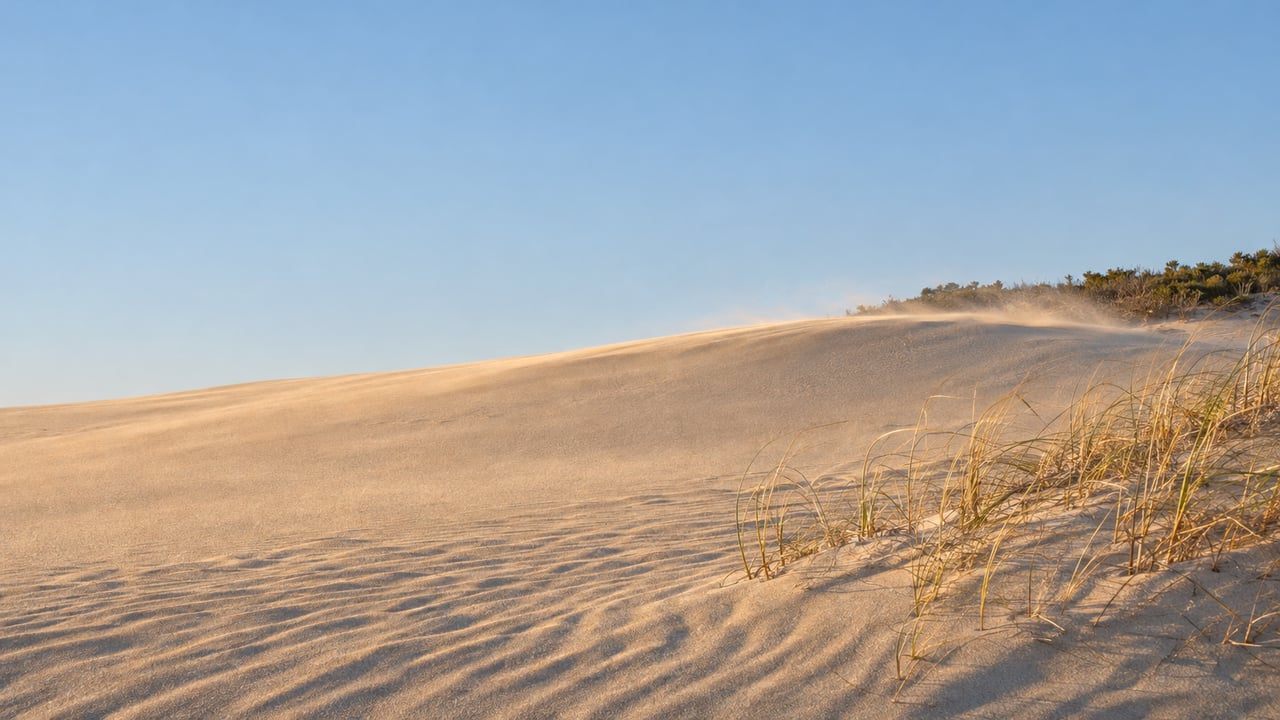
All through the season, the wind is pushing the sand under that tree to the south and southwest, toward the park's edges at West Soundside Road and US 158. Jockey's Ridge travels most in the fall and winter. North Carolina has hauled the dune back from its neighbors in winter before, and in October it began lining up a much larger round of that work.
The best measurements of how the dune moves come from a 2005 study in the journal Geomorphology by H. Mitasova and colleagues. They used wind records from the U.S. Army Corps of Engineers Field Research Facility at Duck, 27 kilometers north of the park. From March through August, southwest winds were dominant. In fall and winter the wind came mostly from the northeast. The stronger winds in the 1982 to 1999 record, 7 to 20 meters per second, came from the north and northeast more often than from any other direction, so more sand moved south and southwest.
The same study measured the dune moving horizontally 3 to 6 meters a year toward the south, roughly 10 to 20 feet a year. That movement had already carried sand past the park boundary and was threatening houses. The study's height numbers show how much the dune changes shape. The main peak was 20.1 meters in 1915 and 41.8 meters in 1953, then back down to 21.9 meters in 2004. That is about 66 feet, then 137, then 72. All of these figures are from 2004 and earlier. The pattern behind them, summer winds from the southwest and stronger winter winds from the northeast, is the one this month's kite-flyers will be standing in.
The park has handled encroaching sand the same way for three decades. It digs the sand out where it has crossed the boundary and moves it back into the dune field.
The 2005 study reports that 15,000 cubic meters of sand were taken off the park's southern boundary in December 1995. In the winter of 2003, a much larger amount was moved to the northwestern side of the dune field, where it could feed the dunes again as a source area. North Carolina State Parks describes the 2003 project in its own records. The 2017 general management plan for Jockey's Ridge says the Division moved about 126,000 cubic yards from the park's south corner to its northern section, because the dune was moving onto private property and threatening buildings there. The average bid for that 2003 work was $565,740.
The 2017 plan also noted that another dune was moving onto private property at the park's east corner. It assumed about 126,000 cubic yards would have to be moved again and estimated $667,573 for design and removal, in 2017 dollars.
The park has also tried slowing the sand down. The 2005 study describes sand fencing put up to slow the south dune, with the fences built up using discarded Christmas trees. The study found the fencing effective at slowing migration and building up the dune.
On October 21, 2026, the North Carolina Department of Natural and Cultural Resources published a solicitation for the next round of this work. The scope is to move about 140,000 cubic yards of accumulated sand from the park-boundary encroachment area near West Soundside Road and US 158 to an approved receiving area inside Jockey's Ridge State Park. The contract also covers evaluating two alternative placement locations, to find one that works financially and environmentally. The third part is evaluating ways to cut down on windblown sand moving from the park onto the adjacent property. Those options will be judged on effectiveness, environmental impact, cost and long-term maintenance. The solicitation listing shows that responses closed at 4 p.m. on November 10.
The total project budget is $2,052,000, according to the HigherGov listing for the sand relocation project. For scale, the 2026 volume is about 14,000 cubic yards more than the 2003 project, and it comes from the corner of the park that faces Nags Head's main roads. The dollar figures cover different scopes, since the 2003 figure is an average bid for removal alone and the 2026 budget also pays for the placement and wind-control studies.
The solicitation comes less than a year after a state vote on the park. Coastal Review reported that the Rules Review Commission approved restoring Jockey's Ridge's Area of Environmental Concern designation at its December 18, 2025, meeting.
The park also has new leadership for this project. North Carolina State Parks named Steve Rogers superintendent of Jockey's Ridge on March 24, 2026. He succeeded Joy Cook, who retired in January.
The park keeps its full program schedule through the windy months. From November through February, the main park is open 8 a.m. to 6 p.m. It closes on Christmas Day and is open the other holidays. The Soundside Access closes earlier in winter, with hours of 8 a.m. to 5 p.m. The visitor center is open daily from 9 a.m. to 4 p.m., per the park's official page. The visitor center is the 6,200-square-foot building that reopened in 2023 after a $2.1 million expansion. Evoke Studio Architecture designed it and A.R. Chesson Construction built it.
These are the free programs on the state's events calendar from Thanksgiving weekend through the end of the year:
The Soundside Loop is a 0.6-mile trail on the side of the park away from the ocean. Tracks in the Sand is a 1.2-mile loop. The 140,000-cubic-yard project targets the boundary near West Soundside Road and US 158, where the sand has already crossed out of the park.
Guests at a Nags Head rental often ask about Jockey's Ridge, and its calendar runs into late December. If you own a rental near the park and want to know whether winter dates like these belong in your booking strategy, Brook Sparks can go over your property's numbers with you. Request your CB Estimate® & Owner Consultation.
Stay up to date on the latest real estate trends.
I provide expert guidance for buyers, investors, and property owners looking to maximize value in coastal real estate. By understanding each client’s goals—whether lifestyle-driven or investment-focused—I help identify properties that align with long-term success. My services also include consulting for existing owners, with strategies focused on pricing, performance optimization, and simple improvements that increase revenue and visibility year-round.