Currituck's Beach Plan Stops at Seabird Way, and a Possible Tax District Is Tied to the Sand
November 12, 2026
November 12, 2026
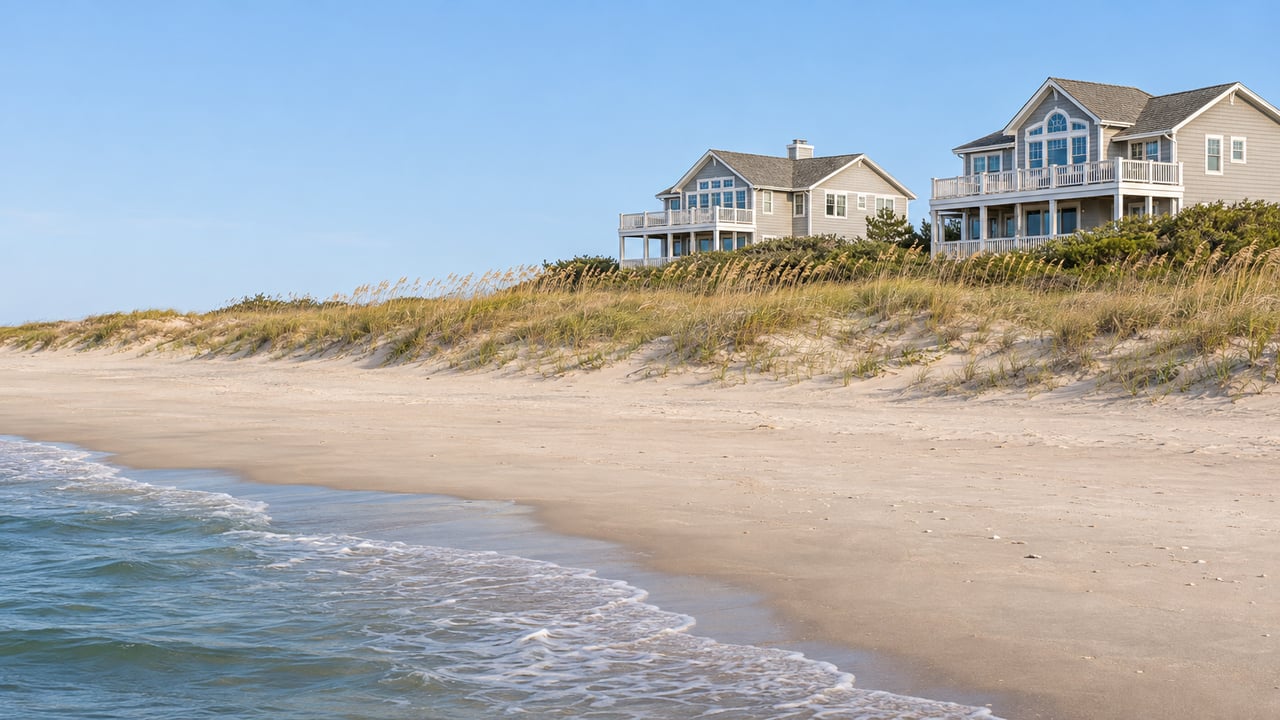
Currituck County's final Beach Management Plan treats Corolla's oceanfront as four separate places. That matters to anyone pricing a house there. North of the Horse Gate, the plan recommends a framework for buying out and removing threatened homes, and that framework will consider whether future buyers should get a formal disclosure. Along 5.7 miles of North Corolla, it recommends a $35.3 million beach nourishment. In Spindrift and South Pine Island it recommends more modeling and no construction. On Nov. 2, commissioners voted to research a taxing service district to help fund the North Corolla project and to survey residents about it.
The plan's benefit math points the sand at North Corolla. Commissioners are researching a taxing service district; its boundaries and rates have not been set.
The plan was prepared by Coastal Protection Engineering and released Oct. 30, 2026. It covers the county's 22.6 miles of oceanfront and divides the trouble spots into reaches.
| Reach | Where it runs | Recommendation | What happens next |
|---|---|---|---|
| Central Reserve/Refuge | North of the Horse Gate, Carova and Reserve/Refuge sections | Buyout and removal program for threatened oceanfront structures | A county-appointed committee drafts a policy framework, expected to take less than a year |
| North Corolla | Northern boundary of Villages at Ocean Hill near the Horse Gate, south to Seabird Way in Ocean Sands | Beach nourishment, about 2.09 million cubic yards of sand | Design refinement and environmental permitting first |
| Spindrift | Oceanfront along Land Fall Court, about 1,200 feet, just north of the Yaupon Lane public access | No alternative recommended for implementation | Shoreline modeling |
| South Pine Island | About 3,000 feet south of the Hampton Inn, east of Hicks Bay Lane and Cottage Cove Road | No alternative recommended for implementation | Shoreline modeling |
The plan names Villages at Ocean Hill, Ocean Hill, Whalehead Beach, Crown Point and Ocean Sands within the North Corolla Reach or its modeled corridor. Those names come from a written description with endpoints. They are not a parcel list. Whether a specific lot falls inside the reach, and later inside any tax district, is a question for the county.
The committee's framework is supposed to settle which structures qualify, whether a buyout would be voluntary or required, how fair market value would be set, where the money comes from, and "whether disclosure requirements should be developed to notify future buyers."
The plan measures what doing nothing would cost in North Corolla. Its list includes ad valorem taxes lost as oceanfront lots become unbuildable, room occupancy taxes that stop when rental houses are lost, and sales tax lost as renters choose other areas. It also counts losses to owners, meaning lost pools and homes, lost rental income and lower property values.
Every item on that list is a tax or income stream tied to property behind the dune. For North Corolla, the plan expects 30-year benefits to outweigh 30-year costs, based on similar assessments. In the plan's words, nourishment is "the only alternative evaluated" there that is expected to meet all of the county's goals and produce a positive benefit-to-cost ratio.
Spindrift's 1,200 feet and South Pine Island's 3,000 feet don't clear that bar. Both were assumed to cost more than they return over 30 years. Initial fill was estimated at $2.2 million to $3.4 million for Spindrift and $2.9 million to $3.8 million for South Pine Island, and both figures assume they piggyback on a North Corolla project. Neither includes the extra sand needed to cover losses as the fill spreads along the shore. For Spindrift, the plan says that could mean two to three times the listed volume. Short projects lose sand at their edges faster. The next step for both reaches includes modeling fill designs paired with coastal structures, which North Carolina general statute currently bans, though the plan notes that removing the ban is under consideration.
Nourishment projects generally perform better the longer they are, the plan says, which can cut maintenance volume. Then it adds that "the longer the project, the greater the number of property owners that would directly benefit from the project which is a consideration if a municipal service district is used to pay for a portion of the project."
The plan does not set a tax rate. It tells the county to build a cost-sharing plan that identifies service districts and rates, outside funding and other revenue. It lists the funding streams successful programs usually combine: state money, county or municipal general funds, room occupancy funds, homeowner payments through service districts or direct assessments, and resilience or pre-disaster mitigation grants.
At the Nov. 2 meeting, the Board of Commissioners narrowed that list. As the Outer Banks Voice reported, most of the discussion was about a service district "where the beach nourishment would occur and which would be taxed to help fund that work." The boundaries have not been decided, and the commissioners agreed residents should be surveyed. The same article quotes the two commissioners whose views frame the issue:
"There is a concern over there. We had washovers on the last Nor'easter. The property values over there do offset everybody else's property values. Not taking care of the area could cost everybody on the mainland more money." Commissioner Tony Angell, who represents the Currituck Outer Banks
Board Chair Paul O'Neal noted that Dare County has spent $375 million on nourishment, said "at some point, it might be a matter of relocating some buildings," and stressed that mainland residents would not be taxed for the project.
Taken together, the plan recommends sand only for North Corolla, the chair said mainland residents would not be taxed for the project, and the plan connects the number of benefiting owners to the length of the fill. The open questions are what the district would include and whether room occupancy money carries part of the cost. The design also assumes the sand gets topped up on a five-year cycle, so the expense comes back. The plan notes that Duck, Southern Shores, Kitty Hawk and Kill Devil Hills are evaluating six- or seven-year intervals.
Currituck has been the only coastal county in North Carolina that has never used beach nourishment. Next door, Dare County's version shows how the costs get split once a program is running.
In Dare, the cost is spread across a county occupancy-tax fund, town-wide levies and district surcharges. Currituck's commissioners have so far discussed one of those three pieces in detail, the district.
The plan's hypothetical schedule starts Nov. 1, 2026 and shows construction as early as 2028. The plan itself calls a 2029 window more practical. County Manager Rebecca Gay told commissioners summer 2029 was more likely than the July to October 2028 window on her slide.
In its Oct. 15 guidance, the county said it had requested activation of the state's Emergency General Permit and that the state had not indicated it would activate it.
The county's Oct. 15 guidance directs owners to Planning & Inspections at 252-232-3055 or [email protected] before starting any work.
Is a beach nourishment tax approved in Corolla? No. On Nov. 2, commissioners approved research, including a resident survey, on a service district. No boundaries or rates have been set.
Would a Spindrift or South Pine Island house be in the district? The plan's nourishment recommendation covers North Corolla only, from Villages at Ocean Hill to Seabird Way. District boundaries are a separate decision still in front of the board.
Where can I read the plan itself? The full 189-page Currituck County Beach Management Plan is posted on the county's website.
This post is general information and is not legal, tax or financial advice. Confirm how any permit or future levy applies to your property with the county and the right professional.
If you own or are underwriting oceanfront in Ocean Hill, Whalehead Beach, Crown Point, Ocean Sands, Spindrift, Pine Island or Carova, the reach your house sits in now belongs in the numbers alongside rents and comparable sales. Brook Sparks can model your rental income and resale value with and without a possible district levy so you can see the range before the survey arrives. Request your CB Estimate® & Owner Consultation.
Stay up to date on the latest real estate trends.
I provide expert guidance for buyers, investors, and property owners looking to maximize value in coastal real estate. By understanding each client’s goals—whether lifestyle-driven or investment-focused—I help identify properties that align with long-term success. My services also include consulting for existing owners, with strategies focused on pricing, performance optimization, and simple improvements that increase revenue and visibility year-round.