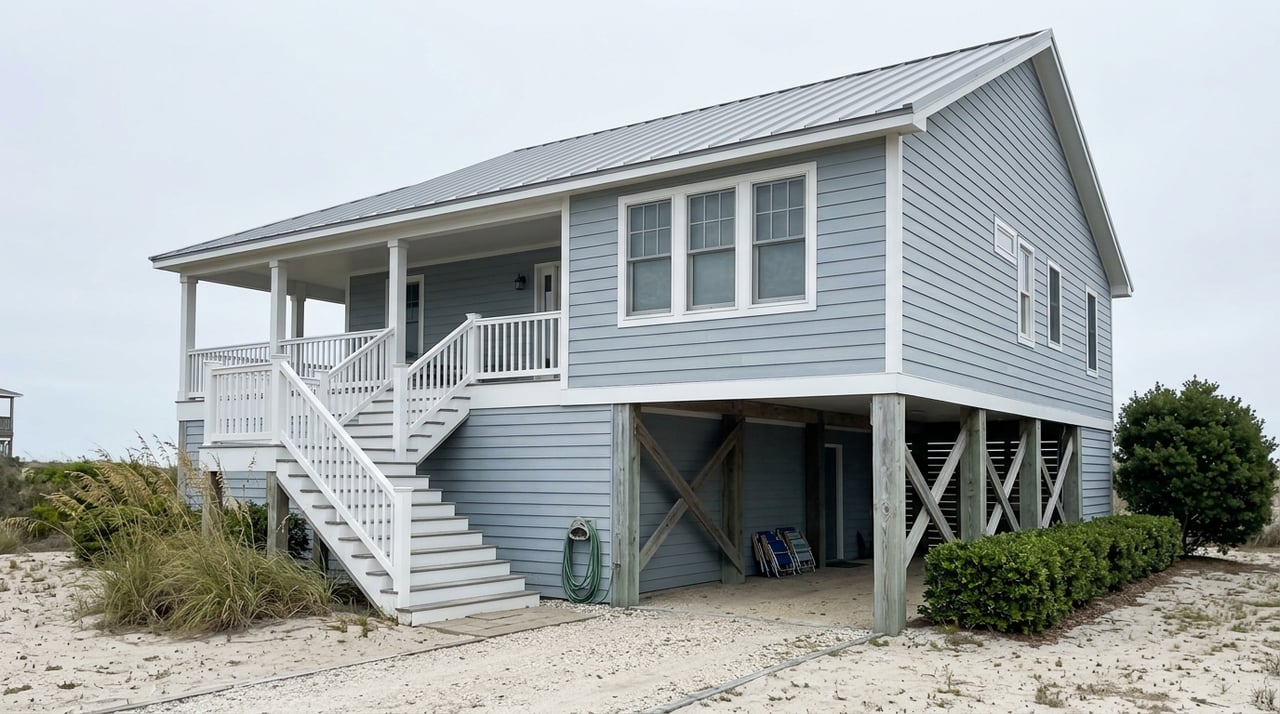
The Septic Question Every Nags Head Buyer Forgets to Ask
September 24, 2026
September 24, 2026
Most buyers touring a Nags Head house ask about the roof, the HVAC, maybe the age of the water heater. Almost nobody asks where the tank is.
That question matters more here than it does almost anywhere else you might have owned property before. If you're coming from a city, a suburb, or even a smaller town with municipal sewer, you're bringing an assumption that doesn't hold on this stretch of the Outer Banks: flush the toilet, and the water disappears into a pipe that belongs to somebody else. In Nags Head, for the large majority of homes, that water doesn't go anywhere but your own back yard.
According to the Town of Nags Head, approximately 80% of properties in town rely on private septic systems rather than a municipal sewer connection. Countywide, the share of homes on septic across Dare County runs even higher. If you've spent your homeownership life somewhere with a sewer bill on the utility statement, this is the first thing to recalibrate before you fall for a listing.
A septic system isn't a defect. Most function for decades with routine care. But it does change what "due diligence" means. You're not just inspecting a house. You're inspecting a small wastewater treatment plant buried in the yard, one that the buyer, not a utility company, is entirely responsible for maintaining after closing.
That responsibility gets more complicated the closer you get to the water.
A septic system is designed to sit at a fixed distance from the shoreline, buried below grade, doing its job quietly for years. Erosion doesn't respect that design. As the beach migrates landward over time, tanks and drainfields that were once safely inland can end up sitting in the surf zone, sometimes fully exposed after a storm.
This isn't a hypothetical. It's the exact scenario the North Carolina Coastal Resources Commission was still working through as recently as this month. At an August 27 meeting held in Dare County, Cameron Luck, a coastal policy analyst with the state's Division of Coastal Management, presented photos of partly submerged septic tanks and debris scattered on the sand, images taken along an eroding stretch of the Outer Banks. His description of the underlying problem is worth reading in full:
"Under the existing framework, we're seeing systems fail, be repaired, remain exposed, and subsequently fail again. The recurrence cycle is one of the primary issues these amendments are intending to address."
That's the mechanism most buyers never think to ask about. A failed septic system near the ocean doesn't just get fixed once and forgotten. Under the current rules, it can be fixed, exposed again by the next storm cycle, and fixed again in roughly the same spot, because state regulations currently give county health departments limited authority to deny a repair permit even when the system sits in a compromised location. At an earlier Coastal Resources Commission meeting this year, Dare County Manager Bobby Outten and state health officials described the same constraint from the county's side: if a proposed repair meets the technical rule, the county is largely required to issue the permit, regardless of how exposed the system already is.
The Commission has not adopted new rules yet. As of the September meeting, the proposed amendments were tabled so environmental and health regulators could keep working together before anything moves forward. That means the rules governing oceanfront septic repair are actively in motion right now, not settled history you can look up and file away.
For a buyer eyeing an oceanfront or near-oceanfront home in Nags Head, this doesn't mean walk away. It means ask sharper questions than the house itself will answer, and don't assume the septic system's compliance today tells you anything permanent about tomorrow.
A few steps turn septic risk from a surprise into a manageable line item:
None of this requires a specialist you have to track down on your own. Dare County's Health Department issues the permits and can confirm a system's history, and Nags Head's own environmental planning staff will talk through what a given property's records mean before you're locked into a contract.
The dollar figures below aren't hypothetical. They're the kind of line items that show up on a repair estimate or a closing statement for a Nags Head property, and they're worth knowing before you're negotiating under a deadline.
| Item | Typical Cost |
|---|---|
| Routine tank pump-out | Around $400 |
| Septic evaluation fee (Dare County Health Dept) | $75 |
| Repair permit fee (Dare County Health Dept) | $75 |
| Drainfield replacement | $1,500 to $3,000, depending on bedroom count and system size |
These aren't emergency-only expenses. They're the maintenance rhythm of owning a septic-dependent property, and for a vacation rental running at high occupancy, that rhythm moves faster than it would for a full-time single-family home. A rental with heavy weekly turnover pushes more volume through the system than a system sized decades ago may have anticipated, which is exactly the kind of detail an investor should fold into their operating budget rather than discover after a tenant complaint.
Here's the part of this story that should change how you think about owning here, not just buying here.
Nags Head runs a dedicated septic assistance program, the Todd D. Krafft Septic Health Initiative, named for the town's longtime environmental planner. The program offers free, non-emergency inspections to homeowners with conventional systems under 3,000 gallons per day. Staff will locate the system, flag whether it needs pumping or repair, and coordinate directly with a contractor if work is needed. Property owners who pump their system through the program can receive a $250 credit on their water account, usable once every three years. For repairs, the town offers low-interest loans up to $12,000 at the prime rate minus 2.5%, repayable over 36 months.
If you're an out-of-state owner managing a property from a distance, this is the kind of resource that turns a maintenance headache into a phone call. It's also exactly the sort of local mechanism that a purely national due-diligence checklist would never surface, because it doesn't exist anywhere else. Reach out to the town's environmental planning office once you close, and put the inspection on your calendar before your first high-occupancy rental season, not after something backs up.
A septic system isn't a reason to avoid Nags Head. It's a reason to ask better questions before you're under contract, especially if the home you're considering sits near the water while state regulators are actively debating how oceanfront systems should be repaired going forward. The buyers who treat septic due diligence the way they'd treat a roof inspection, with records, permit history, and a clear sense of remaining service life, are the ones who avoid the expensive surprise six months after closing.
If you're evaluating a Nags Head property, whether it's a forever home, a second home, or an addition to a rental portfolio, Brook Sparks can walk you through what a specific property's septic and permit history actually means for your offer, your budget, and your operating plan once you own it. Request your CB Estimate® & Owner Consultation to start with the numbers that matter for your situation, not a generic checklist.
Does Nags Head require a septic inspection before I can close on a home? There is no blanket town requirement that a septic system pass inspection before every sale, but lenders frequently require one, and the town's free inspection program through the Krafft Initiative is available to any homeowner who wants documented peace of mind before or after closing.
How do I find septic permit history for a specific Nags Head address? Dare County maintains a public wastewater permit search covering records from January 2005 to the present. You can look up a permit number directly or ask the seller's agent to provide it as part of your due diligence.
Is the current state rule review going to affect septic systems that already have valid permits? As of this writing, the Coastal Resources Commission has tabled its proposed amendments and is continuing to work with state health officials before any new rule is adopted. Existing permits remain valid under current regulations, but any owner considering a repair or replacement near the ocean should ask the county directly whether pending changes could affect their specific parcel.
Stay up to date on the latest real estate trends.


I provide expert guidance for buyers, investors, and property owners looking to maximize value in coastal real estate. By understanding each client’s goals—whether lifestyle-driven or investment-focused—I help identify properties that align with long-term success. My services also include consulting for existing owners, with strategies focused on pricing, performance optimization, and simple improvements that increase revenue and visibility year-round.