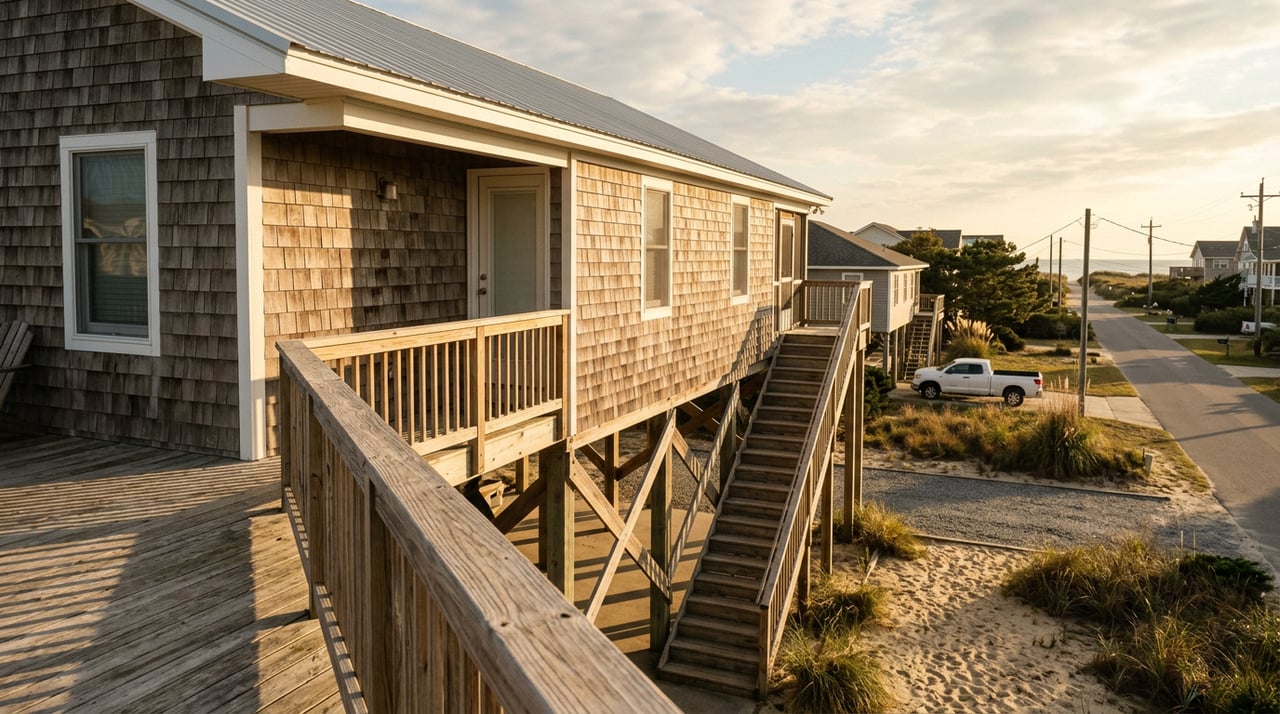
The Nags Head Beach Is Having an Unusually Good Year, and Most of It Is Happening on Your Stretch of Sand
September 3, 2026
September 3, 2026
Walk the beach in Nags Head this week around sunset and you may notice something new roped off in the dry sand, a square no bigger than a card table, orange twine strung between four stakes. If you slow down near one, there is a decent chance someone in a folding chair will wave you over. That is not an accident of a busy tourist season. It is the tail end of the best sea turtle nesting year the northern Outer Banks has recorded since anyone started counting in 2009, and Nags Head is where most of it is playing out.
The Network for Endangered Sea Turtles, known locally as NEST, tallied 57 nests between the Virginia line and South Nags Head as of late August, breaking the previous record of 52 and running well ahead of a ten year average that sits in the low to mid thirties. NEST president Tony Parisi put it plainly back in July when the count was still climbing: the season was tracking "a little higher than average," though he cautioned it could level off at any point. It did not level off. It kept climbing through August, and the town absorbing most of that growth was the one where you probably park your car and walk your dog.
A record season sounds like good news everywhere at once, evenly spread across sixty miles of beach. That is not what happened. Early in the season, when NEST logged its 34th nest of the year on July 11, fourteen of those, the largest share by far, had been found in Nags Head alone. By early August, when the count crossed the old record of 52 and kept going, Nags Head and neighboring Kill Devil Hills together accounted for more than half of everything found that season.
That distinction matters if you live here. A regional record could mean a handful of extra nests scattered from Corolla down to Duck, barely noticeable to any one town. This record means Nags Head itself became the busiest stretch of protected beach on the northern Outer Banks this year, which is why the roped off squares feel more frequent on your walk than they did in past summers. You are not imagining a busier season. The data backs it up, and it is concentrated close to home.
The clearest evidence of how good this season has been arrived on August 30, when NEST reported what it called a rare and exciting claim to fame for a nest tagged Nest 16, laid in Nags Head in late June. Every one of its 114 green sea turtle eggs produced a hatchling, and every one of those hatchlings made it to the ocean. Most of them, 78 to be exact, emerged together on the sixth night of nest sitting a little after 10 p.m. and headed straight for the water. A few more trickled out over the following days. When NEST excavated the nest afterward, the standard procedure once hatching activity has stopped, they found the final 13 hatchlings still alive inside and sent them on their way too.
A perfect hatch rate is unusual on its own. Most nests lose eggs to predators, tidal overwash, or simple embryo failure, and biologists generally expect some loss even in a healthy nest. Getting all 114 out is the kind of outcome NEST staff describe as rare specifically because it almost never happens cleanly. That it happened in Nags Head, in a season where Nags Head already had more monitored nests than anywhere else on the northern beaches, is not entirely coincidence. More nests being watched this closely by this many volunteers means more chances for something to go right, and this year one of them went about as right as it can.
NEST director Jennifer Claflin described the process that makes outcomes like this possible. Volunteers watch a nest for roughly two months after it is laid, and once hatching is close, "we're going to start sitting and watching and monitoring and making sure all of the hatchlings get safely out to the ocean." The tell that hatching is imminent, she said, is a depression in the sand that starts to move. "It's called a boil because the sand, when you're looking at it, it'll start to bubble almost like lava. You can see it moving, and then they'll come out."
Season to date, NEST has recorded just under 1,800 hatchlings across the northern Outer Banks, a number built nest by nest, mostly by volunteers doing exactly what Claflin described, at exactly the hours most residents are walking off dinner or heading home from the beach.
None of this requires a special trip. NEST's own guidance is straightforward: the organization does not publish nest locations, partly to protect the nests and partly to keep traffic and parking manageable in residential areas, but it actively encourages people to walk the beach around sunset, when volunteers typically set up at nests that are close to emerging. If you come across one being monitored, NEST says plainly that visitors are welcome to sit down and join.
What is different this year is the odds of that happening on your ordinary walk are higher than they have been in any season on record, simply because Nags Head has more active nests packed into the same stretch of beach residents already use every evening. That concentration is also why small habits carry more weight this year than in a typical season. A handful of adjustments make a real difference when there are this many nests nearby:
None of these are new rules. What is new is how often they will actually matter this particular August, given how many nests NEST is tracking within Nags Head town limits alone.
There is a version of this story that treats a record nesting season as a pleasant footnote, the kind of thing you skim past in a local news roundup between a ferry toll dispute and a commissioners meeting agenda. The numbers argue against that. A ten year average in the low thirties, a new record above 55, and a town accounting for more than half of that growth is not background noise. It is a measurable shift in what your beach is doing this summer, and it happened close enough to home that most residents could walk to see it without getting in a car.
Brook Sparks has spent enough seasons in Nags Head and Currituck to know that the things worth paying attention to in a place are rarely the ones announced with a press release. They show up as a roped off square in the sand you start noticing on your evening walk, or a number that quietly breaks a seventeen year record while everyone is talking about something else. If you already call Nags Head home, keep an eye out at sunset this week. If you are weighing whether a place like this, one where a walk to the water can turn into an unplanned front row seat to a hatch that made it 114 for 114, fits how you want to live, Brook Sparks is a useful person to talk to about what that life actually looks like, season by season.
Stay up to date on the latest real estate trends.
I provide expert guidance for buyers, investors, and property owners looking to maximize value in coastal real estate. By understanding each client’s goals—whether lifestyle-driven or investment-focused—I help identify properties that align with long-term success. My services also include consulting for existing owners, with strategies focused on pricing, performance optimization, and simple improvements that increase revenue and visibility year-round.